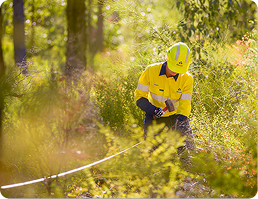

Bauxite benefits, beyond Aluminium.



Bauxite mining contributes to Australian prosperity and drives environmental research, regional workforce development, community partnership and innovative land rehabilitation.
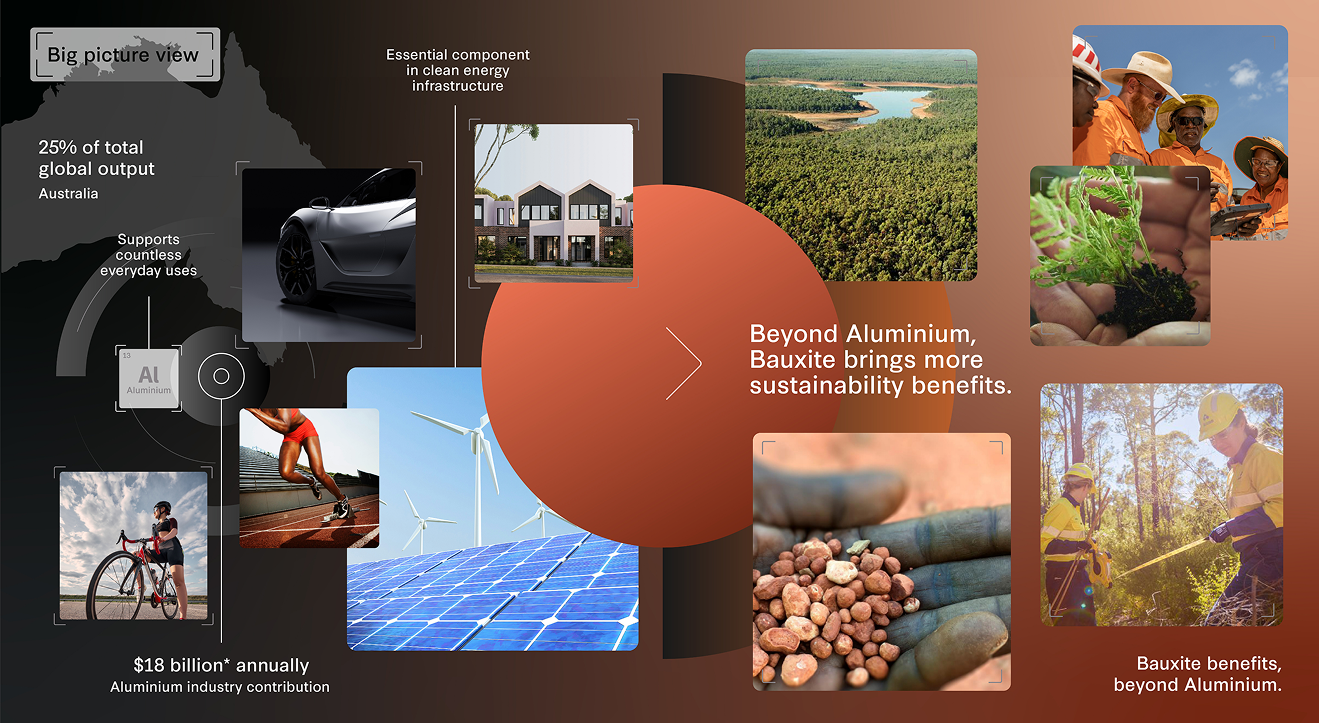
The Australian aluminium industry contributes $18 billion* annually to our national economy. Bauxite mining is the critical first stage of this process. It also drives environmental research, regional workforce development, community partnerships and innovative rehabilitation.
Bauxite benefits our future
Bauxite is the primary ore used to produce aluminium metal, which is closely tied to the world’s renewable and technological future. Aluminium is lightweight and versatile. It is an essential component in many emerging technologies, everyday items and clean energy infrastructure.
Australia is one of the world’s largest bauxite producers, with six metallurgical grade-mines in operation. In 2024, we produced more than 100 million tonnes of bauxite – around 25% of total global output.
The sustainability (r)evolution
With such an important role to play in national and international growth and prosperity, Australian bauxite miners are focused on increasing sustainability across the mining lifecycle.
The Sustainable Bauxite Mining Guidelines – co-authored by the Australian Aluminium Council, the International Aluminium Institute and the Brazilian Aluminium Association – outline 10 core principles to reduce the social and environmental impacts of bauxite mining.
However, leading practice continues to evolve. Beyond minimising impact, bauxite miners are looking to nurture new and positive contributions that are only made possible by the industry.
Regional workforce development
Local opportunities are a major theme for Australian bauxite miners. But it’s about much more than providing work (although the aluminium industry does create about 75,000 Australian jobs). It’s also about training local workers and promoting education and skills development.
Shiona Budby, a Thanikwithi woman from the Cape York Peninsula, manages Rio Tinto’s Amrun bauxite mine. She began her career at the company more than a decade ago through the Local Aboriginal Persons traineeship program. Now, she is committed to nurturing the next generation.
“Building strong relationships through shared lived experiences is the foundation of productivity and success,” Ms Budby said.
Ryan de Franck, managing director of VBX, is developing the Wuudagu Project in remote north Western Australia.
“We are in development, but we are training local people now for our future workforce,” he says.
“VBX has partnered with the Wunambal Gaambera Traditional Owners and regional training providers to deliver a program that covers diverse entry-level skills such as health and safety; an introduction to mining; white card certification; and completion of full pre-employment, medical, drug and alcohol screening.
“Many participants have also been able to gain some practical fieldwork experience.”
Cameron Woolla, a Traditional Owner of the Wik and Wik Waya people of Aurukun, works as a specialist for operational readiness at Glencore’s Aurukun Bauxite Project. The mine is undergoing environmental approvals, but Cameron is similarly focused on long-term capability growth.
“I am working with Traditional Owners to develop an employment strategy that leverages our strengths, skills and knowledge in areas like cultural heritage, biodiversity conservation and field work – while also offering pathways for further learning.
“Local schools and mining companies can also work closely together to build literacy and numeracy foundations. These are crucial life skills for our young people and emerging leaders, which the bauxite industry can help support.”

Community connection and partnership
As well as providing training, many bauxite miners are eager to learn from local communities.
Jaeme Davey is a community engagement and development superintendent for Metro Mining, whose Bauxite Hills mine is located at Skardon River, about 100km north of Weipa in Cape York, Queensland.
“There is a lot for us to learn about building community relationships and First Nations knowledge.
“One of our major successes has been our community seed collection program. In some cases, we have 4 generations of Traditional Owners working alongside each other, collecting native seeds, on Country. It has become an integral part of our progressive rehabilitation methodology.”
South32’s Worsley Alumina operates the Boddington bauxite mine in south-west Western Australia. The team also works with community to strengthen engagement and create a range of mutual benefits.
For example, Worsley Alumina runs regular tours for community members to view and learn about rehabilitation at the Boddington mine. These tours increase transparency and help build understanding of rehabilitation activities.
Rehabilitating land for new purposes
Established by the International Council on Mining and Metals as best practice across the resources sector, progressive rehabilitation – which means rehabilitating while operations are ongoing – has been widely adopted by Australian bauxite miners.
“Bauxite mining lends itself towards progressive rehabilitation, because our operations are shallow and we move across the land,” says Mark Cooksey, managing director and CEO of ABx Group.
“It is not well known that land overlying bauxite often doesn’t perform well for other purposes. That has certainly been the case at all of our Tasmanian mines and deposits.
“It’s land that wouldn’t otherwise be cost effective to upgrade. So, our rehabilitation offers an opportunity to transform sites for more valuable post-mining land use.”
Researching diverse environmental priorities
In 2025, Alcoa opened its Forest Research Centre, consolidating a 40+ year history of environmental research. The centre has $15 million in funding for the next 5 years to support its projects and collaborations with the scientific community.
Dr Lucy Commander, research manager, says the centre has 5 pillars: fauna protection, flora knowledge, rehabilitation, water stewardship, and First Nations 2-way science.
“Our knowledge building is designed to solve really practical problems – for both our business and the wider bauxite mining sector,” Dr Lucy says.
“Our study areas come from around the business and across the mining lifecycle – development, feasibility, pre-operations, operations, closure planning and so on. We received more than 180 research requests, which we aggregated and prioritised.
“Environmental research is a sector that often struggles for funding, so having this commitment from Alcoa is a big win for everyone involved.”
*Australian Aluminium Council, Economic Contribution of the Australian Aluminium Industry
Bauxite mining brings sustainable benefits.
Learn more about new and positive contributions, made possible by industry.